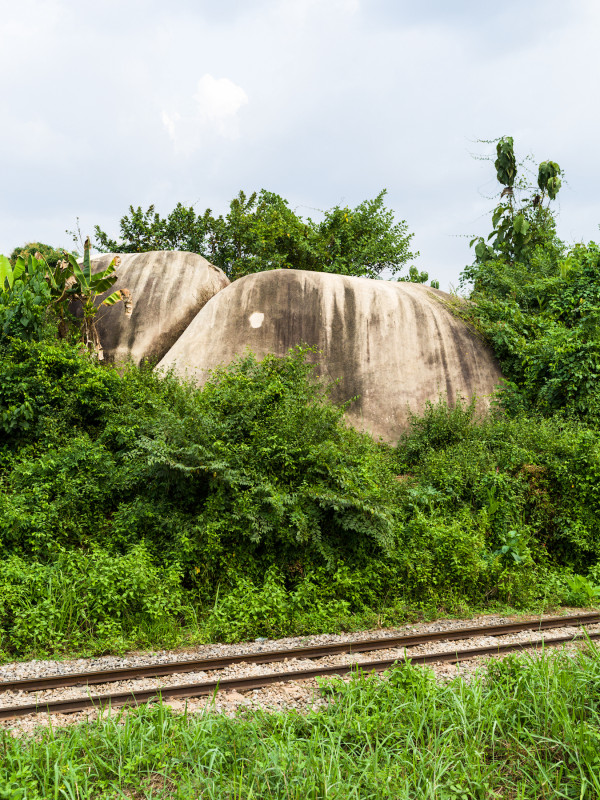
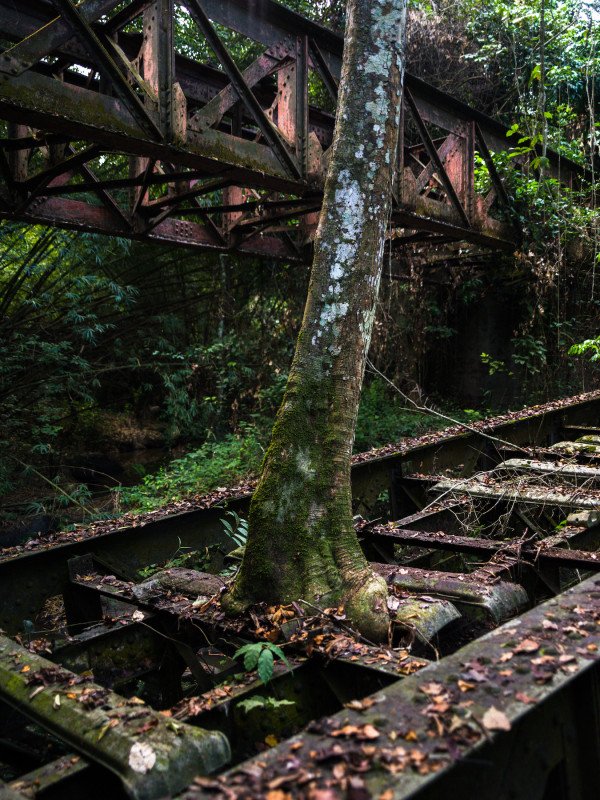
François-Xavier Gbré is drawn to capturing the imprint of human activity on the landscapes and architecture of the African continent. In 2023, the French-Ivorian photographer (b. 1978) set out to follow the north‑to‑south railway line in Côte d’Ivoire. The resulting project is titled
Radio Ballast – referring to the device used to transmit information, and the bed of crushed stone (‘ballast’) on which railroad tracks are traditionally laid. In French railway jargon, ‘radio ballast’ also describes a rumour of uncertain origin – vague, unfounded news, a mixture of gossip and speculation, with muddled or contradictory narratives. History often resembles such a rumour: accounts of the past are rarely simple, but tend to be convoluted or refracted. It falls to the artist to propose possible forms of synthesis – which is precisely what this series strives to achieve. François-Xavier Gbré is the first ever laureate of
Latitudes, a grant programme launched by the Fondation d’entreprise Hermès in partnership with the
Fondation Henri Cartier-Bresson (Paris) and the ICP in New York.
Also on view at the Fondation HCB:
The Monument by
Sibylle Bergemann (1941–2010). From 1975 to 1986, the German photographer documented the creation of the Marx-Engels Monument in East Berlin. The project was initiated by the newly founded GDR after World War II, and eventually entrusted to sculptor Ludwig Engelhardt in 1973, who collaborated with several other artists. Bergemann began taking pictures informally, before receiving an official assignment from the Ministry of Culture in 1977. Over the course of eleven years, she recorded every stage of the process, from the earliest models to the inauguration of the vast double statue on April 4, 1986. Out of more than 400 rolls of developed film, Bergemann selected twelve images whose visual language was far removed from official aesthetics, and consolidated them under the title
Das Denkmal (The Monument). Viewed from a post-communist perspective, her ironic deconstructions of these heroic figures seem remarkably farsighted. By maintaining a rigorously objective style, she managed to evade censorship while bluntly conveying the obsolescence of an ideology.
![01_Sibylle Bergemann, Das Denkmal [Le Monument], Gummlin, Usedom, mai 1984 © Succession Sibylle Bergemann](https://lfi-online.de/webfile/img/10636241/01_Sibylle-Bergemann-Das-Denkmal-Le-Monument-Gummlin-Usedom-mai-1984-Succession-Sibylle-Bergemann.jpg?x=800&y=800)
![04_Sibylle Bergemann, Das Denkmal [Le Monument], Berlin-Est, février 1986 © Succession Sibylle Bergemann](https://lfi-online.de/webfile/img/10636242/04_Sibylle-Bergemann-Das-Denkmal-Le-Monument-Berlin-Est-fe-vrier-1986-Succession-Sibylle-Bergemann.jpg?x=800&y=800)