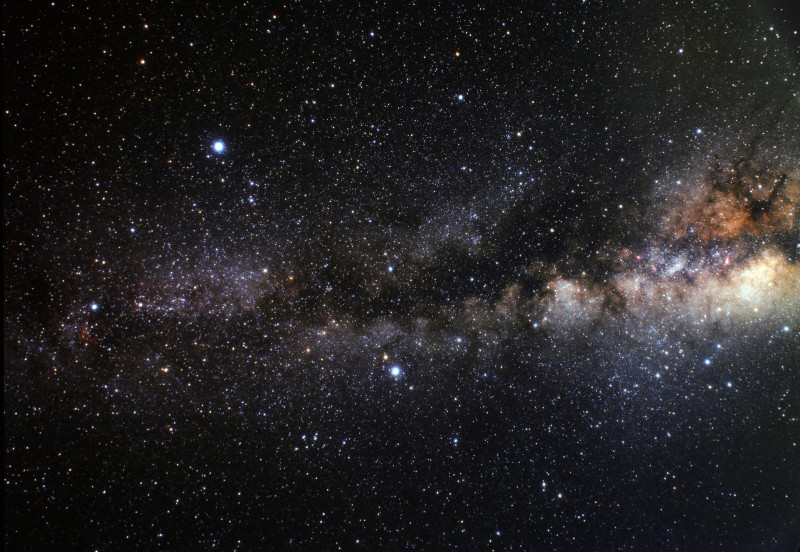
Many photographers are fascinated by the night sky. As we begin our series, we would like to share a few basics with you.
Countless photographs of our starry night sky, some taken from earth, other truly spectacular ones taken in deep space by the Hubble or James Webb telescopes, can be found on the internet. The European Space Agency (ESA) has made many of them available to download in high resolution. Is it the aesthetics of these images that motivates us to pick up the camera ourselves? For astrophotographer and film maker Jamal Ageli, it is primarily about the creative aspect of the realisation, which distinguishes his work from purely scientific or documentary pictures: “Everyone can set their own aesthetic standards and realise their own vision of the cosmos.”
Before you take your first pictures, we would like to give you a couple of basic tips – in addition to Ageli’s suggestions for equipment. In further episodes, we will look at the work presented by astrophotographers in the LFI Gallery.
Our planet not only travels around the sun, it also turns on its own axis. If we point our camera to the night sky, we can capture this rotation – depending on exposure time – as star trails. This can, of course, be deliberate and produce impressive effects, with trails revolving in a circle around the North Star (in the extension of our planet’s axis).
However, if you wish the stars to appear as sharp points, it is important not to exceed a certain exposure time. The rule of thumb for the maximum exposure time for point-shaped stars (with full-frame) is 500 divided by the focal length; at a focal length of 50 mm, this is 10 seconds, and at 24 mm, it is a good 20 seconds.
For pictures of the Milky Way, sensor sensitivity should not exceed ISO 800. In order to collect enough light, you need to take a quick succession of several shots, which are then stacked on the computer to add their light together.
With increasing distances and longer focal lengths, capturing stars as points is often no longer possible, even with single exposures. For example, if you select ISO 1600 and a focal length of 400 mm to capture the Orion Nebula, you will easily end up with 50 to 100 individual exposures. The maximum possible shutter speed is calculated as 1.25 seconds, meaning that the rotation of the Earth must be compensated for by an adjusted movement, using a so-called astro-tracer, which is mounted between the camera and the tripod.
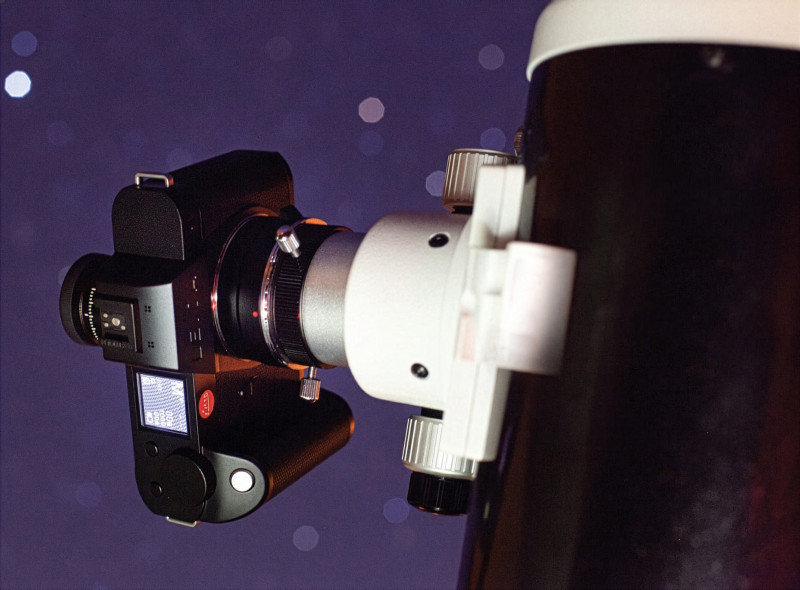
In order to reach for the stars and dive deeply into space, you need the appropriate adapter to connect the camera to a telescope. For the L Mount, Ageli recommends a Baader camera adapter T-2 (thread M42 × 0.75).
If you are looking for a tracking device to compensate for the Earth’s rotation, you need to consider the accessibility of the location from which you will be taking the photographs. For on-the-go photography, Ageli recommends the Sky-Watcher Star Adventurer 2i Wi-Fi Photo Set tracking device. If you are able to deal with somewhat heavier equipment, Ageli suggests Sky-Watcher tracking systems with counterweights, such as the EQ3-2 equatorial mount with tripod (load capacity up to 5 kg) or the SynScan GoTo extension for the Sky-Watcher EQ5 and Vixen GP mounts.
Programmes, such as Stellarium (for computers) or Celestron SkyPortal (on a smart phone), help with orientation to find the various constellations. Furthermore, it is useful to wear warm clothing; have a red light headlamp, and a thermos; and look for a place with as little light pollution as possible.
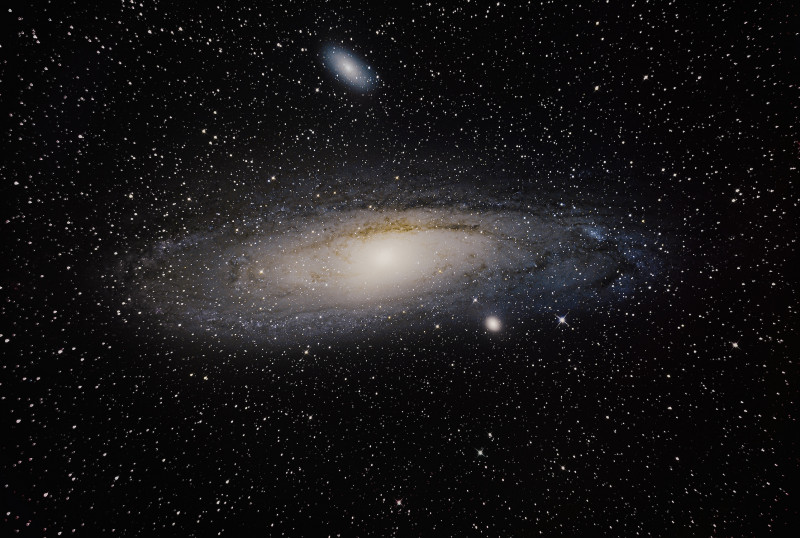
Tobias Habura-SternThe Andromeda Galaxy, photographed by Jamal Ageli with his Leica SL2-S attached to a telescope
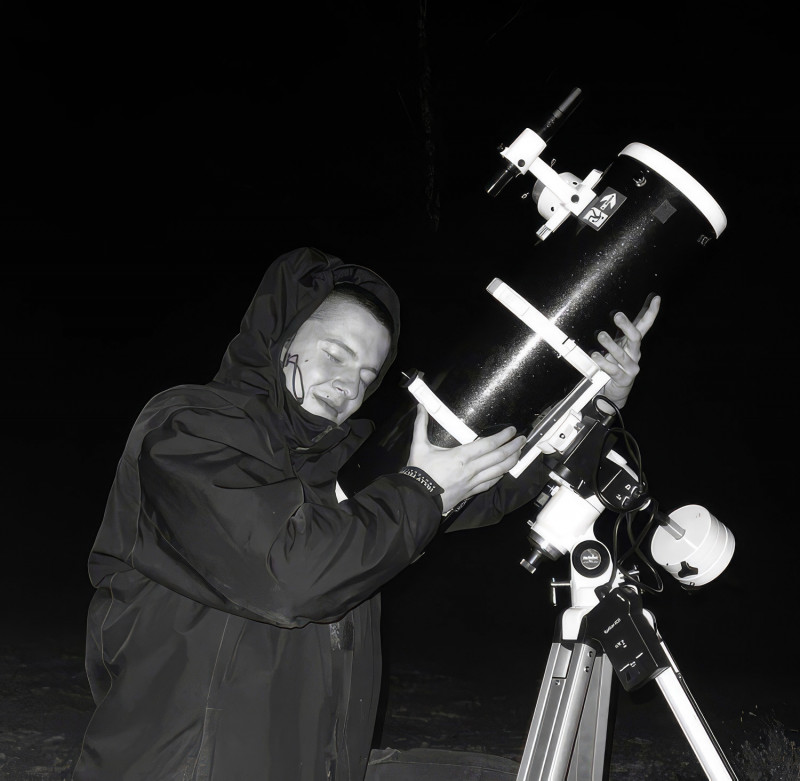
Astrophotographer and film maker Jamal Ageli with his telescope
The Leica SL2-S, mounted on a telescope
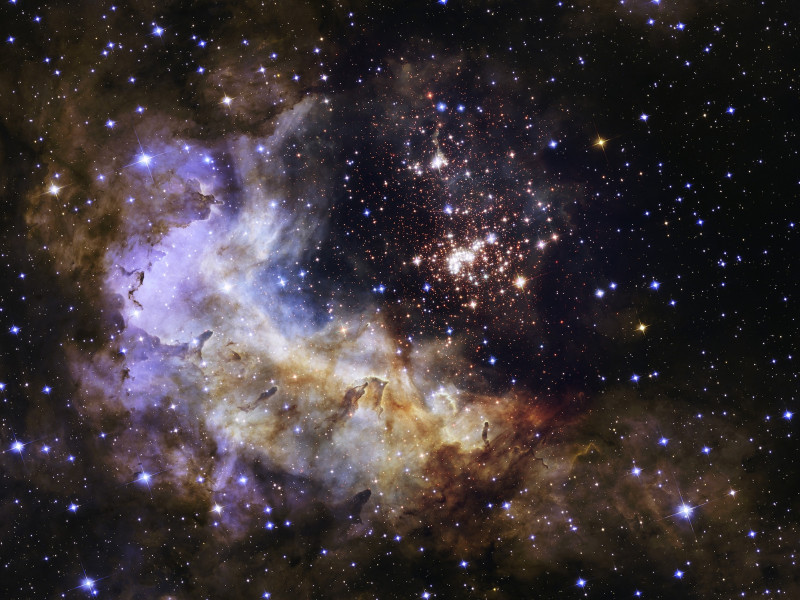
This NASA/ESA Hubble Space Telescope image of the cluster Westerlund 2 and its surroundings has been released to celebrate Hubble’s 25th year in orbit and a quarter of a century of new discoveries, stunning images and outstanding science. The image’s central region, containing the star cluster, blends visible-light data taken by the Advanced Camera for Surveys and near-infrared exposures taken by the Wide Field Camera 3. The surrounding region is composed of visible-light observations taken by the Advanced Camera for Surveys | Photo © NASA, ESA, the Hubble Heritage Team (STScI/AURA), A. Nota (ESA/STScI), and the Westerlund 2 Science Team
Here we have the Summer Triangle constellation, made up of three bright stars: Vega (above left), Altair (in the middle below) and Deneb (far left). Discovered in 2005, the exoplanet HD 189733 b circles a star located very close to the centre of the triangle. HD 189733 b is an extremely hot gas giant around 64 light years from Earth; it is considered exceedingly hostile to life | Photo © ESA, A. Fujii