Martin Hartley’s impressive images document the consequences of climate change. We spoke with him about the challenges of expedition photography.
Conditions were harsh when Pen Hadow and his three-man expedition team reached the geographic North Pole on May 12, 2010 after 60 gruelling days crossing the steadily shrinking ice of the northern polar region. For experienced expedition photographer Martin Hartley – who has been accompanying expeditions across Asia and the North and South Polar regions for over 15 years – this extreme environment was nothing new. His first expedition took him to Nepal in 1993 for the 40th anniversary of the first ascent of Mount Everest, followed shortly afterwards by trips to Kyrgyzstan, Borneo and India. In 2001, he visited Antarctica for the first time, and the following year took him to Baffin Island off the north-east coast of Canada. In 2006, he was at the North Pole for the first time, as part of the Top of the World tour from Russia to Canada. But for Hartley and the team, it is not just about the challenges: the expedition team wants to use emotional imagery and accounts to draw attention to the consequences of man-made climate change.
Just recently, Hartley accompanied the Ocean Census Arctic Deep Expedition, which discovered numerous previously unknown species in the depths of the Arctic Ocean – contributing to a better understanding of life in the oceans that cover around seven-tenths of our planet. We had the opportunity to talk with Hartley about his expedition preparations and photographic equipment, before he sets off on a new expedition from Canada to Greenland to document the state of the ice masses along the way.
LFI: Together with Ann Daniels and as part of a three-man expedition team led by Pen Hadow, you reached the geographic North Pole 15 years ago. Back then you already reported about the disappearing ice. What has happened to the nature there in the meantime?
Martin Hartley: Since my 2010 North Pole expedition, the Arctic sea ice reached the lowest recorded minimum in September 2012, and March this year (2025) the Arctic Sea reached its lowest ever recorded maximum extent. The decade between 2011 – 2020 has been the warmest on record. During that time I went back to the Arctic five times, including two North Pole expeditions in 2014 and 2017, to collect data for space agencies NASA and ESA (European Space Agency). Nature’s response to the continued dwindling of Arctic Ocean sea ice has made our climate a lot more volatile – including changes in the jet stream –, leading to more extreme weather events. There has not been a full North Pole expedition now since 2014.
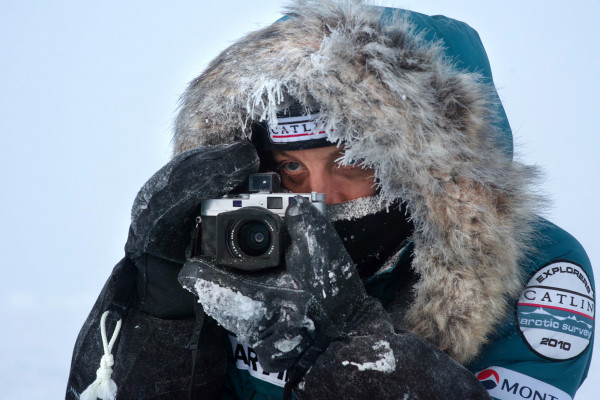
Back then you documented with an analogue Leica MP 0.72, which was later auctioned at Leitz Photographica. Why did you use an analogue camera and why, specifically, a Leica MP?
I used the Leica MP analogue camera on my 2010 expedition for a few reasons. One, because I wanted a mechanical camera that I knew would work below minus 50 Celsius in high humidity. Two, I needed a camera that didn’t rely on battery power, as I had no way to charge batteries due to the low light at that time of the year, and the heavy cloud cover on most days would inhibit any solar charging (I took a Weston light meter for the light readings).
Shooting on film offered the most robust archival properties for the images, a guaranteed way to preserve the pictures for the next 100 years. Also I wanted to shoot a modern Arctic expedition in black and white film, to see how the images compared to a North Pole expedition that had been photographed a hundred years ago. On a more personal and, indeed, romantic note, while on a long North Pole expedition in 2009, I remember skiing along in a big storm at some point towards the end of the expedition – on day 60 or 70 or sometime around then –, and I made a promise to myself to photograph my next Arctic Ocean expedition on a Leica camera to experience the Leica effect; not the way the lenses work but to feel how it is to hold a Leica and how it would feel to drive it in an extreme environment.
Ultimately, I wanted to see how the pictures were different from other cameras I had used. I was 41 years old, I had been a professional photographer for 20 years, and I said to myself on that 2009 expedition, “I’ll buy a Leica when I’m a good enough photographer.” I’m smiling now, but I was quite serious at the time…and yes, I still feel that pressure to take a great photo when holding a Leica, which comes from a place of knowing that so many photographs taken on Leica cameras have shaped our knowledge of history and the messages of truth, something that seems to be slipping away from the world we live in today.
How do you prepare yourself and your equipment for such an extreme expedition?
I prepare myself mentally in the weeks leading up to an Arctic Ocean expedition. One way is when I go to bed at night I imagine myself on the Arctic Ocean in my tent in the darkness, floating around on a raft of moving ice, like a ship without an anchor, to the sound of the ice breaking up around me, as far away from rescue as is possible to get on this planet. This mind rehearsal prepares me, so that the shock to my mind on the first nights of the expedition isn’t such a shock. Physically I have to be robust and mobile.
Being a photographer is a physical job anywhere, but on an expedition you have two jobs, not one: one role is as an expedition team member; the other is the expedition photographer. Training in the winter, going out when its cold and getting tired builds resilience in both body and mind. All the equipment for an extended North Pole expedition needs to be stress-tested in the cold. If anything has a weakness, the cold will find it – whether in a piece of equipment or in a person. The Arctic Ocean is a special place on earth: if it’s minus 40 Celsius outside the tent, then it’s minus 40 Celsius inside the tent. Unlike Antarctica there is a “greenhouse effect inside the tent”. On the Arctic Ocean, nothing escapes the cold, and that weighs heavy on your mind 24/7. The only way to escape the pressure of the cold to be creative, is to lean on and into the sense of purpose of why I’m there as a photographer. Arctic Ocean expeditions are in a word “brutal”. They are painful from beginning to end, physically and emotionally. The reason for my being there as an expedition photographer, does not remove the suffering, but it gives me a profound sense of purpose, and that is my power to escape the cold.
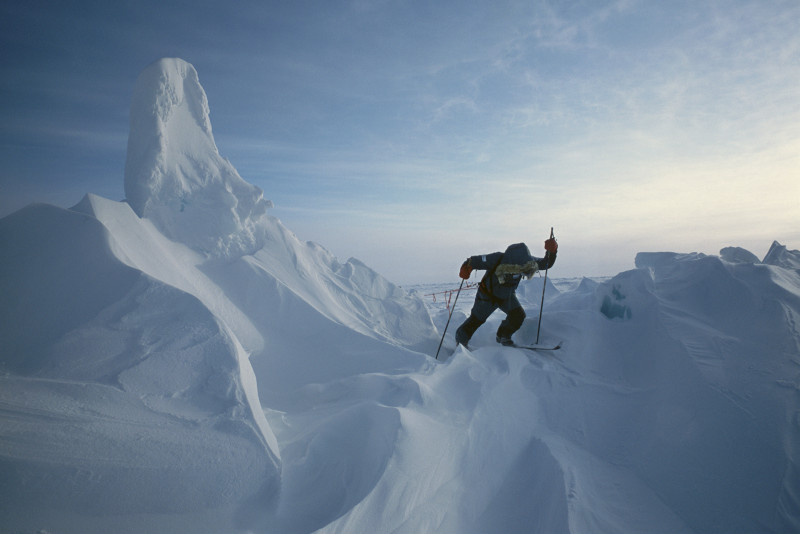
Tobias Habura-SternWith every step on the Arctic Ocean there is an unknown ahead, nothing is a familiar pattern, everything changes with each step. Having to navigate through, around, under and over frozen ice obstacles in our way is absolutely normal. This is one of the great challenges presented by the Arctic Ocean
This block of sea ice is ice that was formed during the previous autumn, winter and spring. This ice is usually on average 1.7m thick and is barely able to survive the heat of the summer months when it is exposed 24/7 to solar radiation. This will have melted by the end of the summer
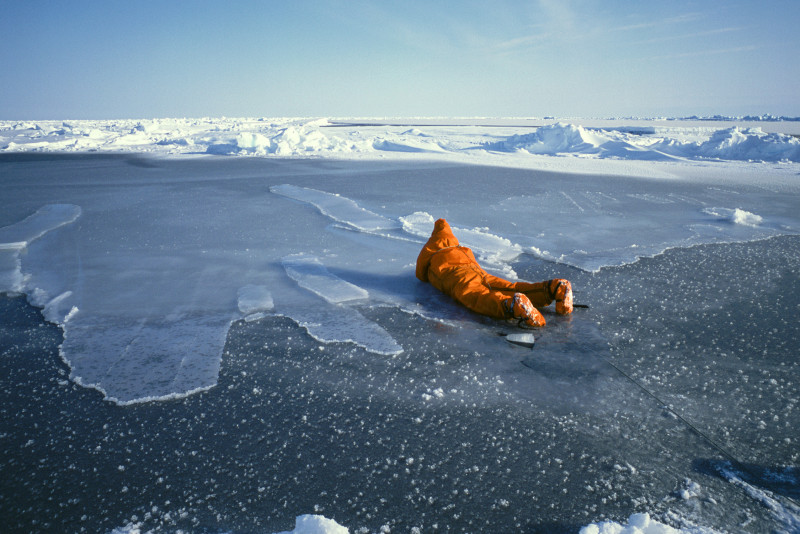
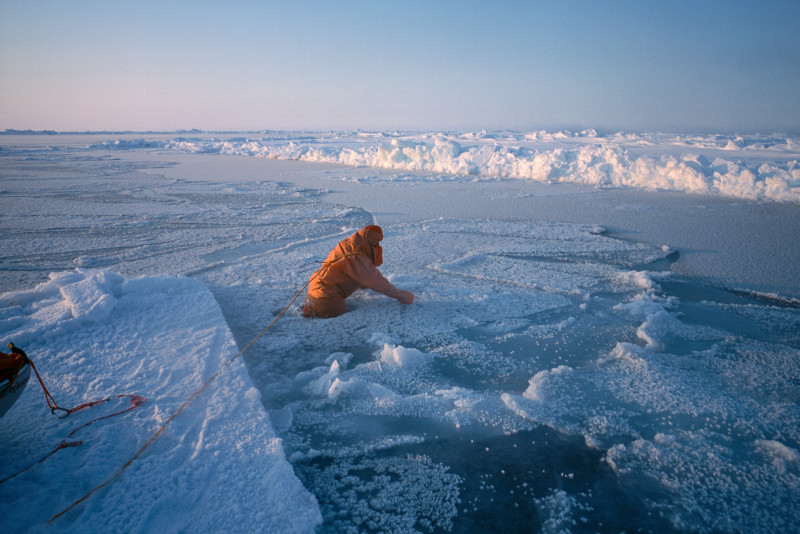
Ann Daniels crawls her way across an area of ice that has formed overnight between our tent and the safety of thicker ice a few metres away. This technique known as a ”Polar Bear Crawl” spreads body weight over the ice to minimise the risk of falling though.
Ann Daniels falls through the ice attempting to cross an area of thin ice to reach safer thicker ice, on her way to complete a 777km expedition to the Geographic North Pole in 2010
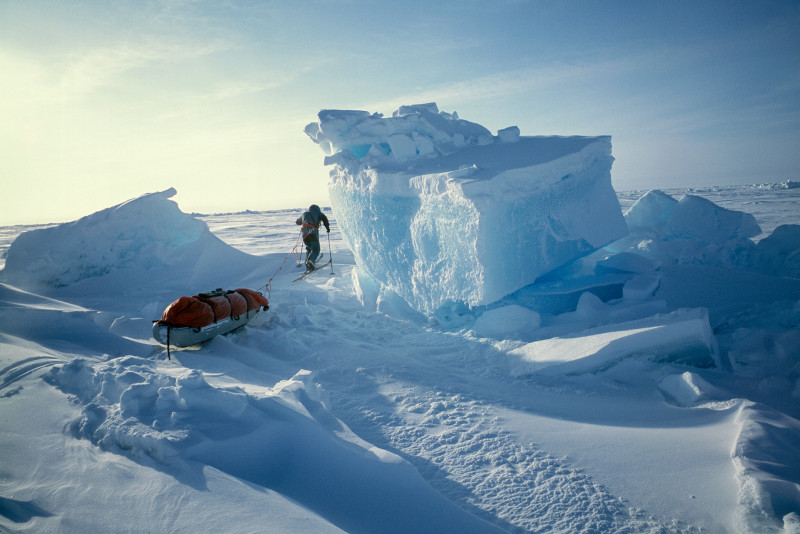
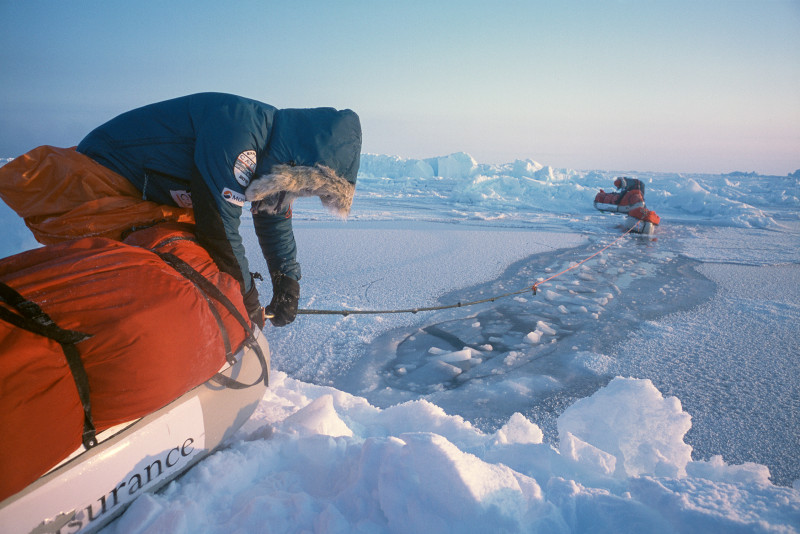
Crossing thin ice on the Arctic Ocean demands a high level of experience and judgment, to get across dangerous and difficult areas using equal varied techniques. Here we are using a safety line to haul the sledges as small boats, to get from from one side of thicker ice to the other
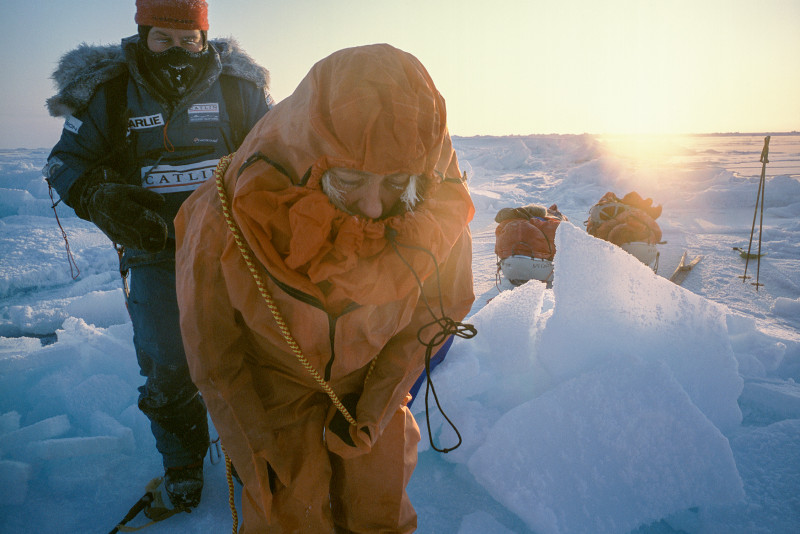
Ann Daniels squeezes the air out from the inside of her immersion suit, before heading out to swim across an area of open water during the 2009 Catlin Arctic Survey. The air temperature on that day was minus 37 Degrees Celsius. At these temperatures nothing is easy
100 Leica Stories+-
Frozen Frames. In 2010, Martin Hartley used a Leica MP to document his expedition to the North Pole. While digital cameras failed at the temperatures of up to minus 45º C, the mechanical Leica proved its worth on the 777-kilometre journey. More
Martin Hartley+-
For more than two decades, the photographer has documented the Arctic sea ice, covering over 2,000 miles on expeditions. His images appear in major international publications and have earned numerous awards, including Time Magazine’s “Hero of the Environment.” In addition to his expeditions, he collaborates with scientific teams from the ESA, NASA, and major research programmes. Exhibitions across several continents highlight the cultural and scientific significance of his work. More