
On the Cover Photo
On the Cover Photo
Joel Meyerowitz
June 30, 2025

Joel Meyerowitz, Street scene in New York City, 1976 © Joel Meyerowitz
The picture was taken in down-town Manhattan almost fifty years ago, on the corner of West 46th Street and Seventh Avenue. At a first glance, it appears to be a chaos of colours and shapes, advertisements, patterns and materials. However, as is always the case with Joel Meyerowitz’s photographs, the confusion quickly clears, uncovering a multitude of details and stories that draw the viewer’s gaze deeper and deeper into the subject. The image itself also opens up unusual depth in its centre, revealing a section of the grey-blue sky at the end of the street canyon.
“Photography is just about seeing,” says Meyerowitz, who has longed been considered an exemplary representative of street and colour photography. “Photography has taught me everything I know about the world and about myself.” In the photo book Die Lizenz zu Sehen (License to See), the photographer summarises his most important tips for street photography. “The street belongs to you,” he begins. “But how do you go about taking pictures on the street? First of all, you have to want to know life on the street. Street means chaos. If you can feel comfortable in chaos, you’ll find your way. On the street, you need to keep your eye on the whole picture. The territory that you see through the viewfinder belongs to you. One of the most interesting things about street photography is creating connections between things that don’t have anything in common, because, when you bring them into the same picture, you create that connection. When you dive fully into street life, by, for example, hanging around on a popular street corner, something will sooner or later draw your attention: people moving in some manner or other, all kinds of interesting gestures and faces, and the interplay of different events. You observe how the idiosyncrasies of everyday things unfold right under your nose. With photography it’s just about reacting to things that catch your attention, and creating a connection.”
Meyerowitz certainly managed to do this very effectively in the motif used for the cover of LFI 5.2025. Even half a century after it was taken, the picture continues to intrigue viewers, without revealing all its secrets and stories.
Ulrich Rüter“Photography is just about seeing,” says Meyerowitz, who has longed been considered an exemplary representative of street and colour photography. “Photography has taught me everything I know about the world and about myself.” In the photo book Die Lizenz zu Sehen (License to See), the photographer summarises his most important tips for street photography. “The street belongs to you,” he begins. “But how do you go about taking pictures on the street? First of all, you have to want to know life on the street. Street means chaos. If you can feel comfortable in chaos, you’ll find your way. On the street, you need to keep your eye on the whole picture. The territory that you see through the viewfinder belongs to you. One of the most interesting things about street photography is creating connections between things that don’t have anything in common, because, when you bring them into the same picture, you create that connection. When you dive fully into street life, by, for example, hanging around on a popular street corner, something will sooner or later draw your attention: people moving in some manner or other, all kinds of interesting gestures and faces, and the interplay of different events. You observe how the idiosyncrasies of everyday things unfold right under your nose. With photography it’s just about reacting to things that catch your attention, and creating a connection.”
Meyerowitz certainly managed to do this very effectively in the motif used for the cover of LFI 5.2025. Even half a century after it was taken, the picture continues to intrigue viewers, without revealing all its secrets and stories.
EQUIPMENT: Leica M2
LFI 5.2025+-

LFI 5.2025 The Leica Classic portfolio dedicated to the work of Joel Meyerowitz appears in issue 5.2025 of the LFI magazine. More
Joel Meyerowitz+-
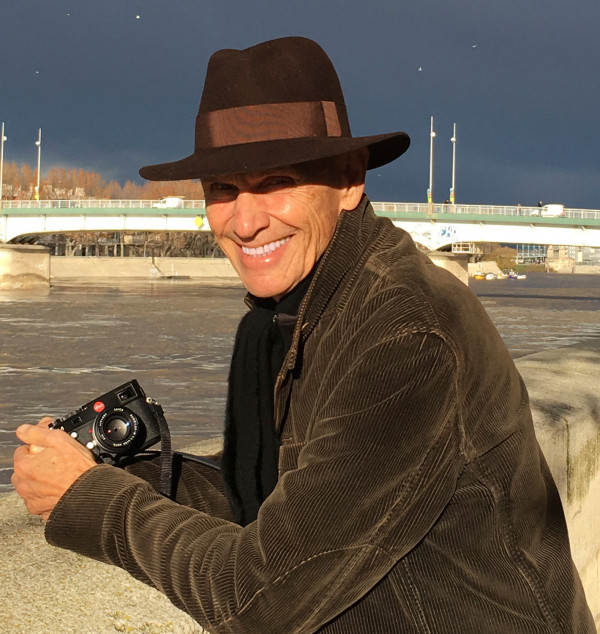
Born on March 6, 1938 in New York City. Initially studied painting before working as an art director. Since the 1960s, he counts among the key representatives of American street and New Color photography. His first Leica was an M2, followed by the M4 and M6. Four-month trip through the USA (1964) and one-year trip through Europe (1966–1967). In 1970, he used his Guggenheim Fellowship for another journey across the United States. Continues to use the M and S systems for street photography, still lifes, portraits and commissioned projects to this day. In 2016, Joel Meyerowitz was honoured with the Leica Hall of Fame Award for his life’s work. He lives and works between New York and London. More
Joel Meyerowitz, Street scene in New York City, 1976 © Joel Meyerowitz