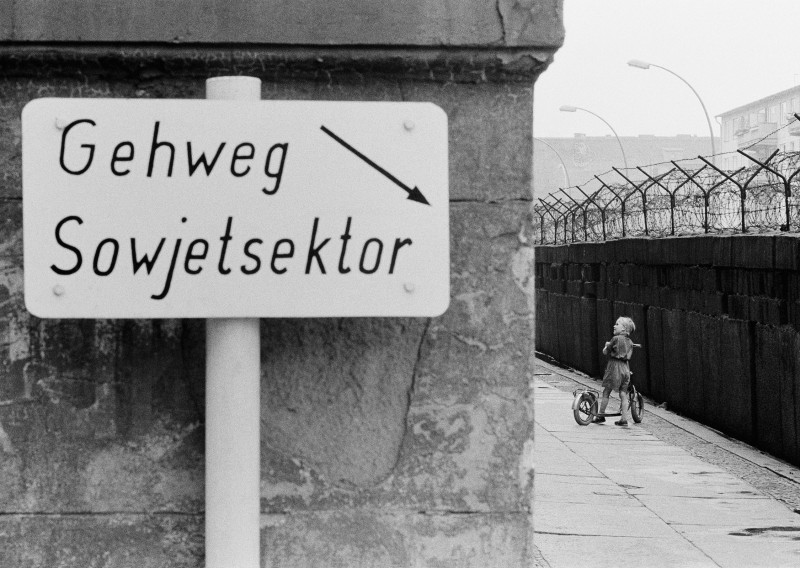
For French photojournalist Édouard Elias, the most authentic depiction is captured in the picture series. Even so, there are two individual images by Leica Hall of Fame winner Thomas Hoepker that he finds particularly fascinating.
When the first 35mm camera introduced the ability to produce series of images, photojournalists gained a tool that allowed them maximum discretion and flexibility in their reporting. The reportage photography genre grew to become one of the most important pillars of Leica photography. Two prominent representatives, French photographer Édouard Elias and Leica Hall of Fame winner Thomas Hoepker, are now engaging in a visual dialogue at the Leica Gallery Paris. Their images provide insight into war and crisis zones around the world and are powerful reminders of moments in contemporary history. Elias is particularly impressed by Hoepker’s talent for creating clear compositions that reflect ambivalence.
Édouard Elias: “For me, being a photo-journalist, and specialized in covering actuality, photography finds its true meaning in a series of images, with a text and context, rather than a single isolated shot. Each photo is part of a larger whole that tells a more complex and nuanced story. Most of the photographers in the Leica Hall of Fame inspire me precisely because of their ability to create cohesive visual narratives, where each image enriches and complements the others. One photo can be powerful, but it is through a series that we can grasp the richness of human, social, or political realities. Their work has taught me that a story isn’t told in a single moment.
One image by Thomas Hoepker that I’m particularly drawn to is of children playing beside the Berlin Wall. What interests me is not so much the historical subject as the framing and composition: the Wall becomes a simple part of the urban backdrop. The tension between a heavily charged background and the ordinary or joyful activity in the foreground appears throughout Hoepker’s work.
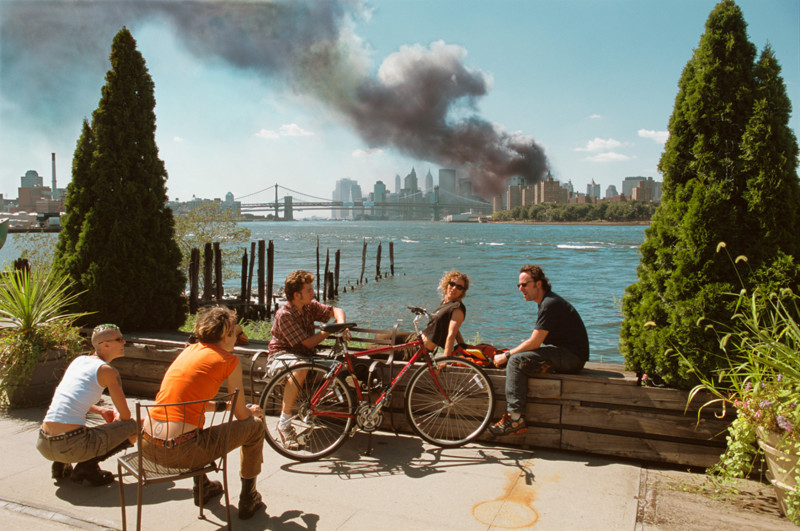
We see the same visual construction in his 9/11 photograph, where everyday life continues as a historical catastrophe unfolds in the distance. That way of structuring reality without emphasizing, without underlining speaks to me deeply.”
View from Williamsburg, Brooklyn, on Manhattan, New York, USA, September 11, 2001
Child with Scooter at the Berlin Wall, Germany, 1963
In Conversation+-
The exhibition will be on view from the 25th of August until the 16th of October at the Leica Gallery Paris.
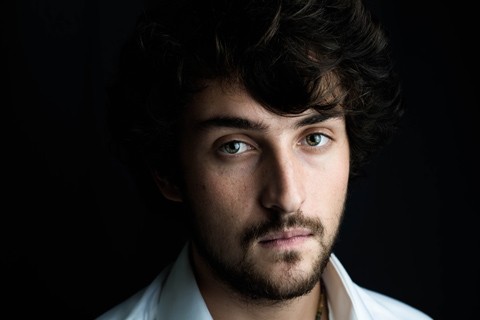
Édouard Elias+-
Born in Nîmes in 1991. After spending ten years in Egypt, Elias returned to France and studied photography at the Écoles de Condé in Nancy. After doing a reportage on a refugee camp in Turkey, he began to document the Syrian civil war. He spent ten months in prison there. His work has appeared in Der Spiegel, Paris Match and Sunday Times Magazine. More
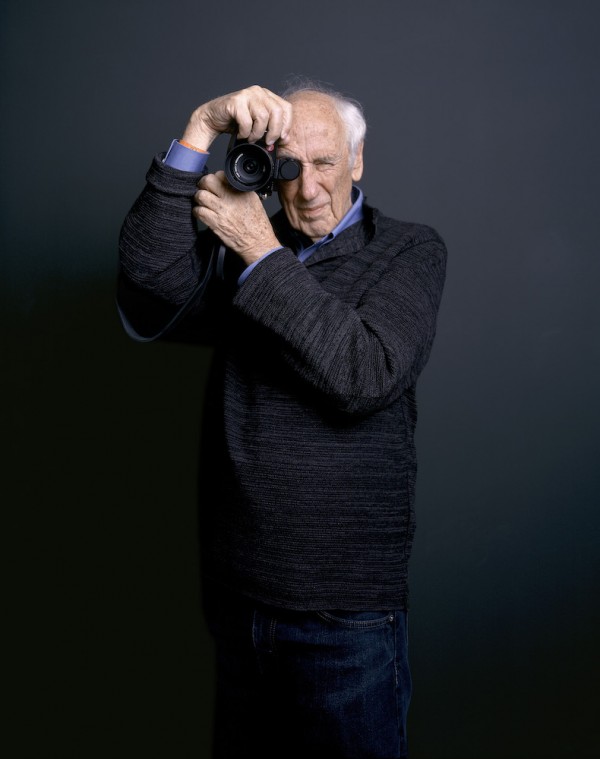
Thomas Hoepker+-
born in Munich in 1936. Early successes and awards. Photo reporter for the Münchner Illustrierten in 1960; as of 1962 member of the Kristall editorial team, then working for Stern as of 1964. In addition to black and white pictures, Hoepker is able to produce early colour pictures for the magazine. Here too, his Leica is his indispensable work tool. Starting in the 1970s, he also works as a cameraman producing numerous documentary and TV movies. Hoepker moves to New York in 1976, and from 1978 to 1981 is the Executive Editor of the American edition of GEO. He returns to Hamburg and works as Art Director for Stern's chief editorial team. In 1989 he becomes the first German member of the renowned Magnum Photos Agency, acting as its President from 2003 to 2007. He produces further documentaries with his second wife, the film maker Christine Kruchen. He is the recipient of numerous awards, including the Culture Prize of the German Photographic Society (DGPh) in 1968. In 2005, thousands of photographs are donated to the Photography Museum in the city of Munich. In 2014 Hoepker is honoured with the Leica Hall of Fame Award. After a long illness, he passed away on July 10, 2024 in Santiago de Chile. More