The French photographer and his Leica cameras explore the phenomenon of loneliness in Chinese megacities.
The protagonists of Emmanuel Serna’s Stories from China series appear at times melancholy, introverted or enigmatic. The photographer was out and about exploring Chinese megacities with his M8 and M10. Despite the large crowds, the Frenchman, who has been living permanently in Hong Kong since 2010, often encountered expressions of loneliness. The phenomenon of isolation was a leitmotif through his series. Another thread is the enigmatic aspect of Chinese culture that foreigners in particular experience. He spoke with us about his Stories from China series and shares some impressions he brought back from his forays.
LFI: Your series Stories from China is about individuals, the alienation and loneliness that can be felt in the vastness of Chinese cities. How do you define loneliness?
Emmanuel Serna: For me, loneliness is a state. Beyond being physically alone in a place, it’s also a moment where we find ourselves, ignoring others. It can be chosen, but it can also be forced, and thus lead to alienation.
From your observations, are people in China more lonely than in Europe?
In big cities, I think so. First of all, these cities are huge and often overcrowded. This immensity increases solitude. People don’t know each other, they don’t have time to communicate. In addition, many Chinese have been displaced from their villages or neighbourhoods, often destroyed to make way for buildings. The community life that existed in these places has disappeared, thus creating loneliness and alienation.
How did you come up with the idea for this series? When was this series photographed, and is it ongoing?
I took the first photos in 2007 and 2008 while travelling for other projects. At first, I hadn’t decided to work on this theme in particular. But the photos appeared to me during editing and I decided to explore it further. Yes, I continue to take photos around this theme, but I’m not looking for lonely people everywhere because that would be cheating. I prefer to wait for the moments when this solitude and alienation seem to really exist. I chose to call this series Stories from China, because when you look at these photos, you don’t always know what’s going on and you can tell your own story.
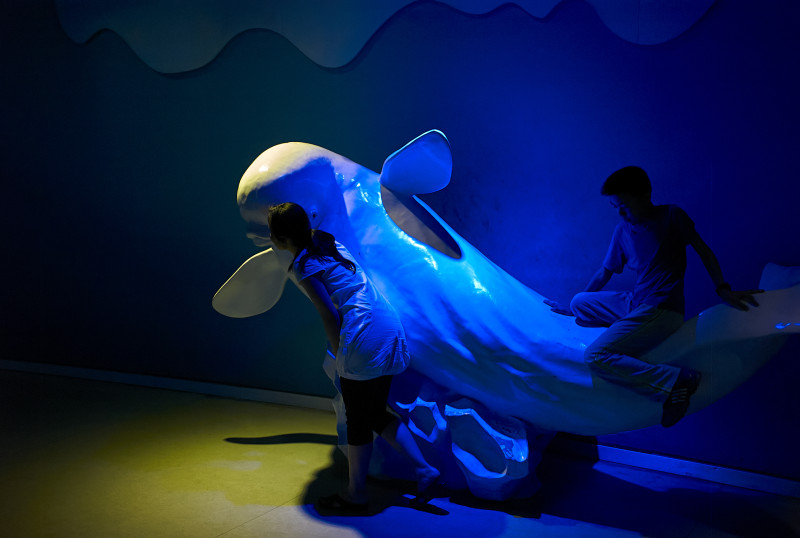
Let’s talk about a few images in particular: what is this whale costume about?
It’s a statue in an the ocean theme park. I took this photo because I was drawn to the colours, the attitude of the two children, and especially that of the boy on the right, who seems to me to be experiencing a moment of solitude in this seemingly unsuitable place.
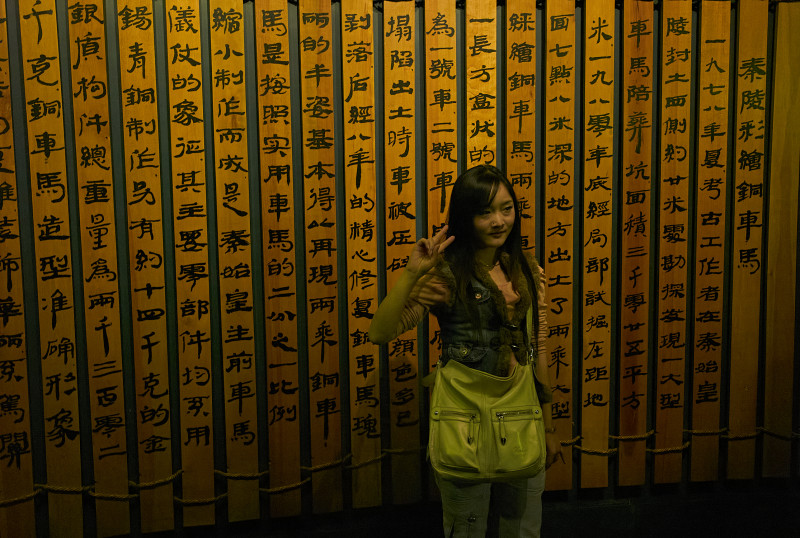
Young woman with handbag in front of wooden panels, showing a victory sign. What is this woman referring to?
She poses in front of panels detailing the biography of the first king of the Qing Dynasty. The victory sign is common in China and Asia and has no real meaning.
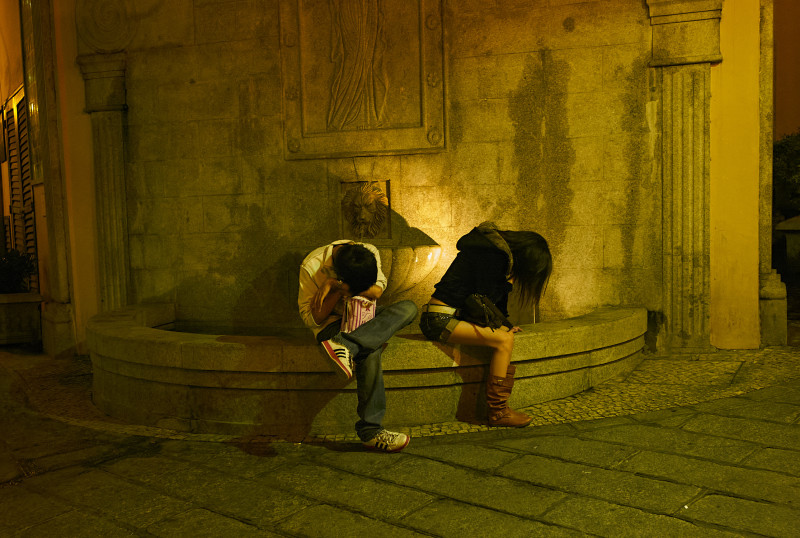
Two young people sit at the edge of a fountain; what are they doing there?
Very honestly, I don’t know what they’re doing there, because I photographed them at that precise moment and they didn't move after the photo and I didn’t stay. I think they were resting or had just had an argument.
What do you wish for the people in Chinese megacities and their loneliness?
Quite naively, I wish that the Chinese government would stop destroying their villages and traditional neighbourhoods and preserve the authenticity of their culture.
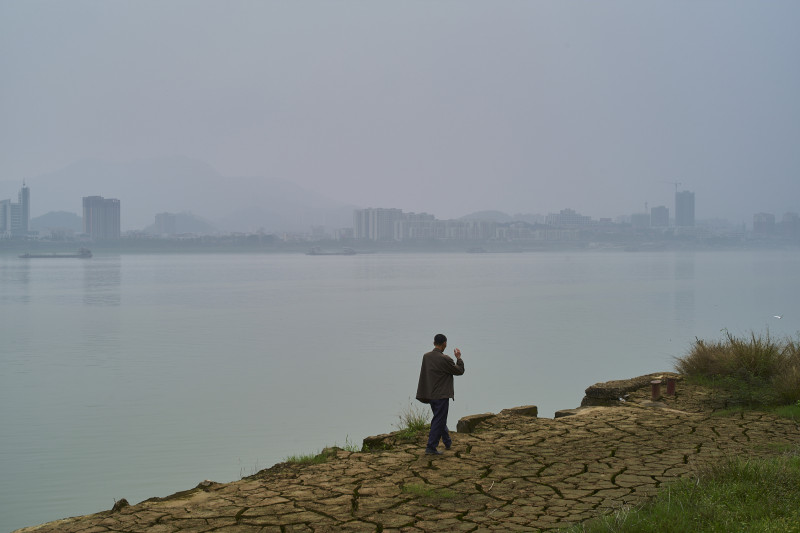
Carla Susanne ErdmannA man walks talking to himself along the edge of a river, Zhaoqing 2023
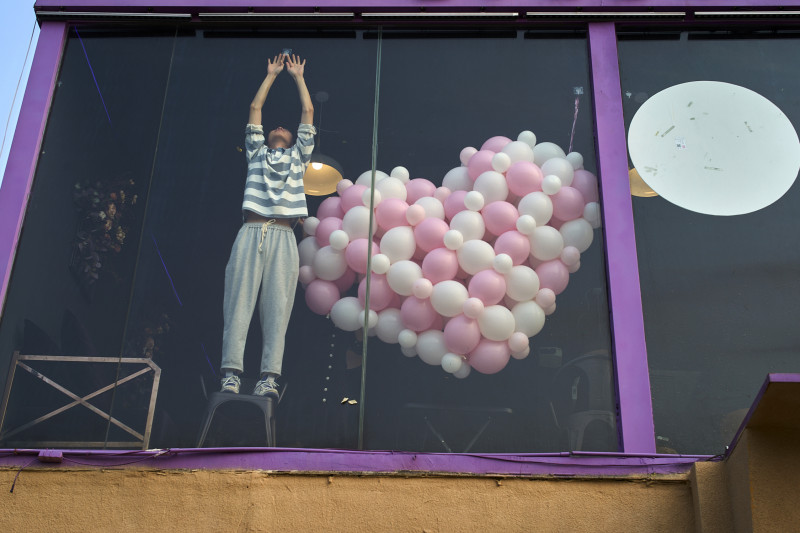
A young man sticks a balloon heart to a window, Zhaoqing 2023
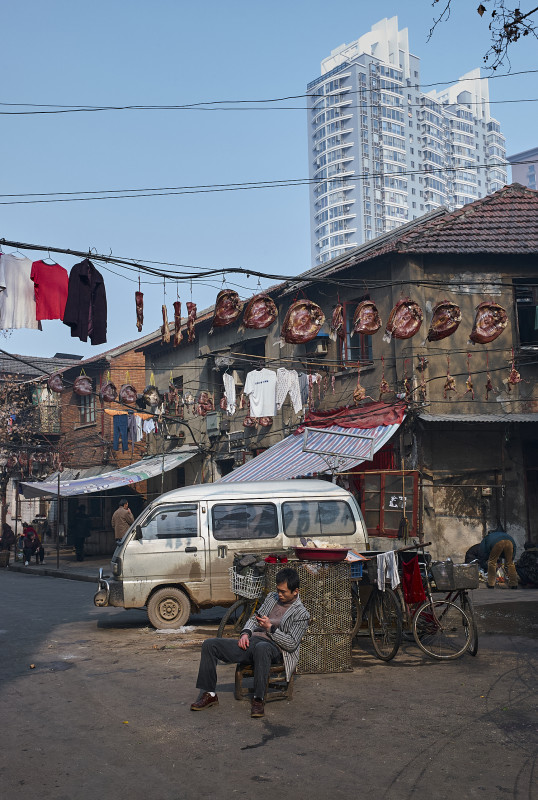
A man looks at his cell phone while sitting in the middle of a street, Wuhan 2008
A couple sits on the edge of a fountain, Macao 2007
A young woman poses for a photo in a theme park, Xian 2011
Children play on a whale statue in a theme park, Wuhan 2013
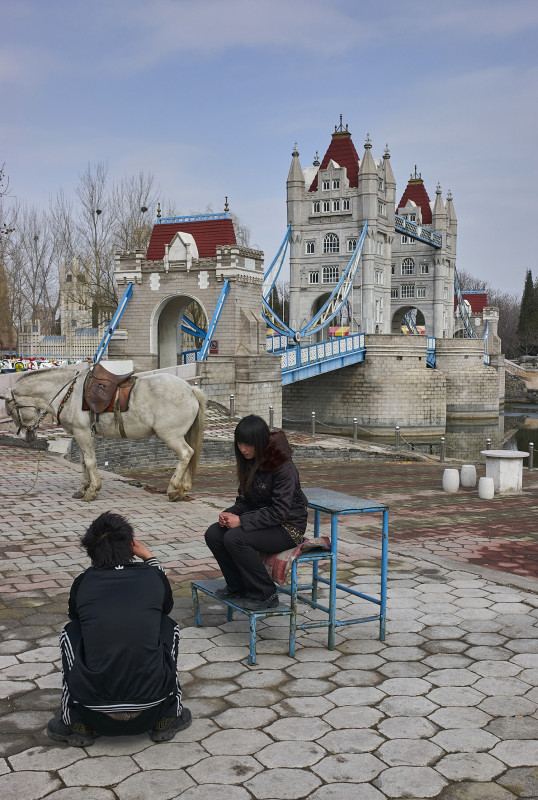
Employees wait for customers in a theme park, Beijing 2009
EQUIPMENT: Leica M8, M10, Elmarit-M 28 f/2.8, Summilux-M 35 f/1.4, Summilux-M 50 f/1.4, Summicron-M 35 f/2 Asph
Emmanuel Serna+-
Born in Lunel, southern France in 1973, Serna studied Photography at the CE3P – École des techniques de l’image, Ivry-sur-Seine, in 1998. He then studied Press Photography in 2004, at the École des métiers de l’information (EMI) in Paris. In 2016, he took part in the Magnum Photos Educa-tional Program directed by Patrick Zachmann. His work has appeared in, i.a., The New York Times, Paris Match, El Periódico, and Ming Pao. More