A new photo book reconstructs, in great detail, the life and work of a forgotten Hamburg photographer.
Publications about Sigmund Freud rarely appear without a photograph by Max Halberstadt. His portraits of the Viennese psychoanalyst are still used today, but the producer of the images is only credited in the rarest of cases – either out of ignorance or indifference. The Hamburg photographer (1882–1940) is mostly unknown, even though he was once one of the most famous portraitists of the bourgeoisie in the Hanseatic City of Hamburg. It is thanks to the meticulous and persistent research carried out by historian Wilfried Weinke for this lavish tome, that Halberstadt’s biography and the fate of his family have now been rescued from obscurity. Over many decades, Weinke went around the world following scattered traces of the photographer and, after presenting initial texts and an exhibition three years ago, he has now completed this photo book, together with designer Uwe Franzen. It is an important first step, as well as an exemplary example of a project documenting the life stories of individuals who once defined the cultural landscape of Germany, but who were persecuted for reasons of race, forced into exile or exterminated.
After training at the Hamburg atelier of Rudolf Dührkoop and pursuing further photographic work in Leipzig, Munich, Basel and Paris, Halberstadt established his first studio in October of 1907. A few years later, in 1912, he opened a new atelier at the best of business addresses on the Neuer Wall, Hamburg, which was already a glamorous promenade for the bourgeois citizens of the city. Among his clientele were numerous celebrities and artists, including Sigmund Freud, who had already taken advantage of a trip to Hamburg in 1909 to have his portrait taken. Three years later a close family connection arose, when Freud’s youngest daughter, Sophie, became engaged to the photographer. The couple married the following year and went on to have two sons. Their happiness was short-lived, however, as Sophie Halberstadt died from the Spanish Flu in 1920, at age 26; the younger son died in 1923. That same year, Halberstadt married Bertha Katzenstein, who had previously worked in the office at his atelier. Daughter Eva was born in 1925.
When the Nazis gained power, the Jewish photographer was subject to racial persecution. In 1936, the family managed to emigrate to South Africa; but Halberstadt died at just 58 years of age in Johannesburg in December of 1940, having succumbed to the effects of years of stress and the challenging task of starting a new life.
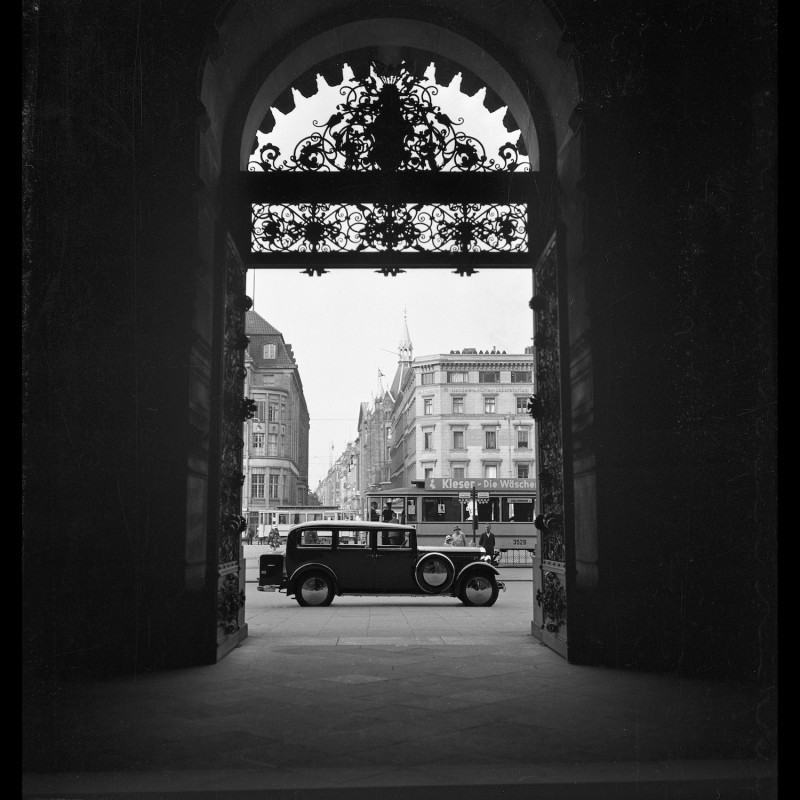
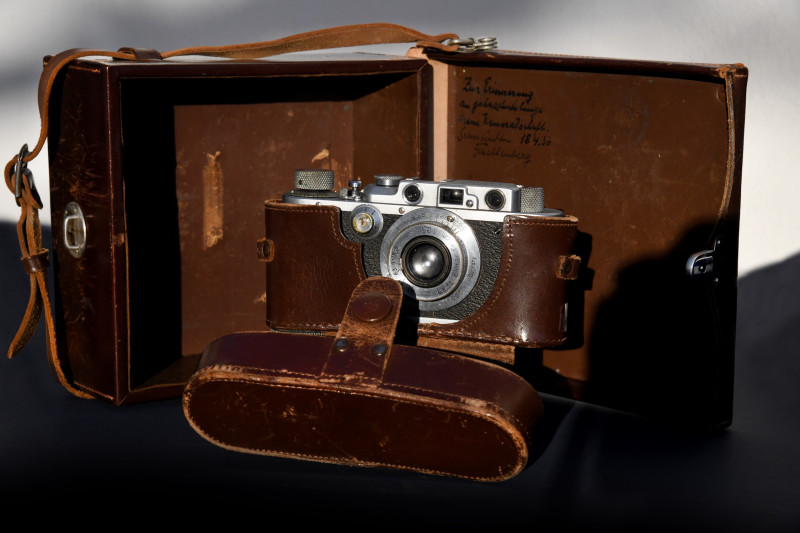
Little proof remained of his career as a photographer. However, this photo book manages to vividly showcase Halberstadt’s stylistic diversity as a portrait and children’s photographer, specialist for interiors, city photographer and modern advertising designer. A special discovery is finding that he was also highly regarded by many of his colleagues: Kurt Schallenberg and Raimund F. Schmiedt – founding members of the former GDL (Society of German Photographers) of which Halberstadt had also been a member since 1920 – gave their friend and colleague a Leica IIIa, as a farewell gift before he embarked for South Africa. The intention was to help him make a new start.
Halberstadt’s fate is not simply a story from the darkest chapter of German history; it also demonstrates a lack of willingness to come to terms with the injustices of the Second World War. The annihilation of Jewish life, the erasure of historic records, and the ignorance of many institutions – all mean that many personalities are still missing today from Germany’s cultural memory. And it is becoming increasingly difficult to interview the last remaining eyewitnesses. Tragically, this photo book divulges far more than just the story of a family and a photographer.
Ulrich RüterMax Halberstadt: Sigmund Freud, undated, Spangenthal Collection, England
Max Halberstadt: View through the Entrance to the Hamburg Town Hall, Rosenthal Collection, USA
Max Halberstadt: Hamburg, View of the Elbe at Landungsbrücken, Rosenthal Collection, USA
Max Halberstadt: Banana Selling at the Altona Fish Market, Rosenthal Collection, USA
Max Halberstadt: Drafts for advertisements, Spangenthal Collection, England
Halberstadt’s Leica IIIa, serial number 208512 with Leitz Elmar lens, Rosenthal Collection, USA
Personal dedication by Kurt Schallenberg and Raimund F. Schmiedt: In memory of decades of loyal camaraderie. Schmiedt, Schallenberg, 18.4.1936
The Photographer Max Halberstadt+-
Producers: Wilfried Weinke and Uwe Franzen.
With contributions by Carsten Brosda, Rolf Sachsse and Wilfried Weinke.
Design by Uwe Franzen, atelier hand work 2.0.
304 pages, ca. 300 images
22 × 30 cm, German and with English sub-chapters and picture captions. Hirmer Verlag